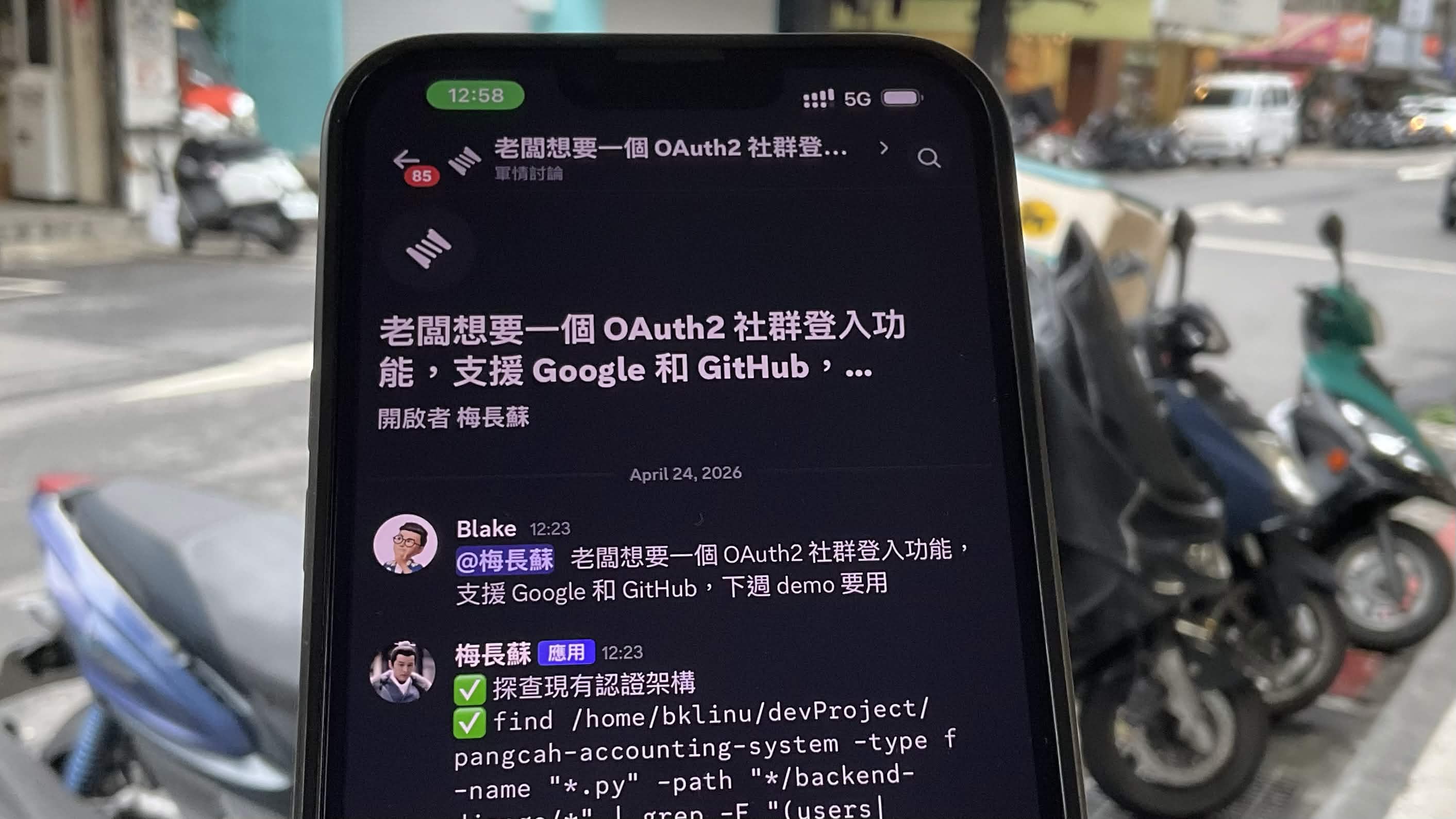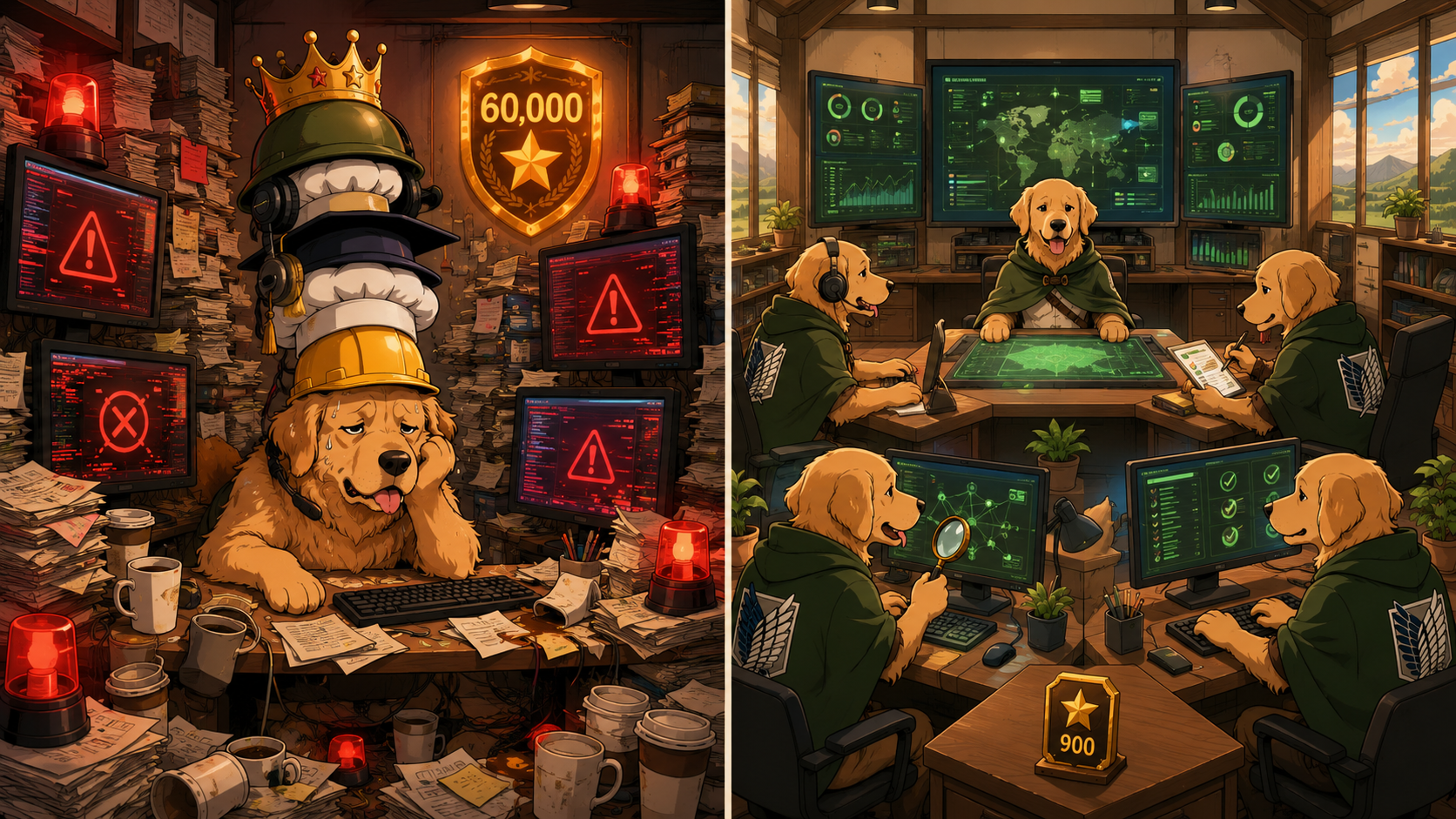
Honestly, I Didn't Even Install It
Late 2025, I started seriously integrating AI agents into my workflow.
Like everyone else, the first thing I looked at was OpenClaw. Most recommended, biggest community, tutorials everywhere.
But I never installed it. I killed it during evaluation:
Known security vulnerabilities — visit a malicious webpage and your agent gets hijacked
40,000 users found exposed on the public internet
335 malicious plugins in the official marketplace
Default: agent gets full access to all files and environment variables
I don't need to fall in the pit to know it's there. Put these numbers on a slide for your CTO, and the meeting ends right there.
Buying a lock and leaving it in the drawer is the same as having no lock. I didn't even buy it.
Then I Remembered 2016
I spent two years at BotPartner building chatbots. Back then AI was terrible. NLP couldn't understand a thing users said.
So we didn't guess. This matters — we didn't guess.
We designed flows:
User enters
  │
  ├── Check balance? → Balance module
  ├── Report issue? → Support module
  ├── Buy something? → Shop module
  └── None of the above? → Transfer to human
Layer by layer. Each step collected information. By the end you knew:
Who this person is
What they want
Which module should handle it
Their path through the flow = the log
I trained 200+ developers on this, presented at Computex and MWC Spain. The company eventually shut down, but the routing logic stuck with me.
The interesting part: in 2026, AI is 10,000x stronger, and nobody does this anymore.
Everyone's approach became: one powerful AI, throw everything at it, let it figure it out.
Wait — wasn't the whole reason we designed routing in 2016 because "guessing" didn't work? Does routing lose its value when AI gets smarter?
No. The value of routing was never "because AI is dumb." It's:
Route first | Throw at one AI | |
|---|---|---|
Token cost | Simple tasks use small models, saves money | Everything uses top-tier, burns cash |
User profiling | Each flow step collects info | Black box, AI guesses |
Response quality | Right agent for the right problem | Luck of the draw |
Traceability | Every step is a log | One black box |
Routing's value is control. Not compensating for dumb AI. The stronger the AI, the more control matters.
The Survey Corps Goes Outside the Walls
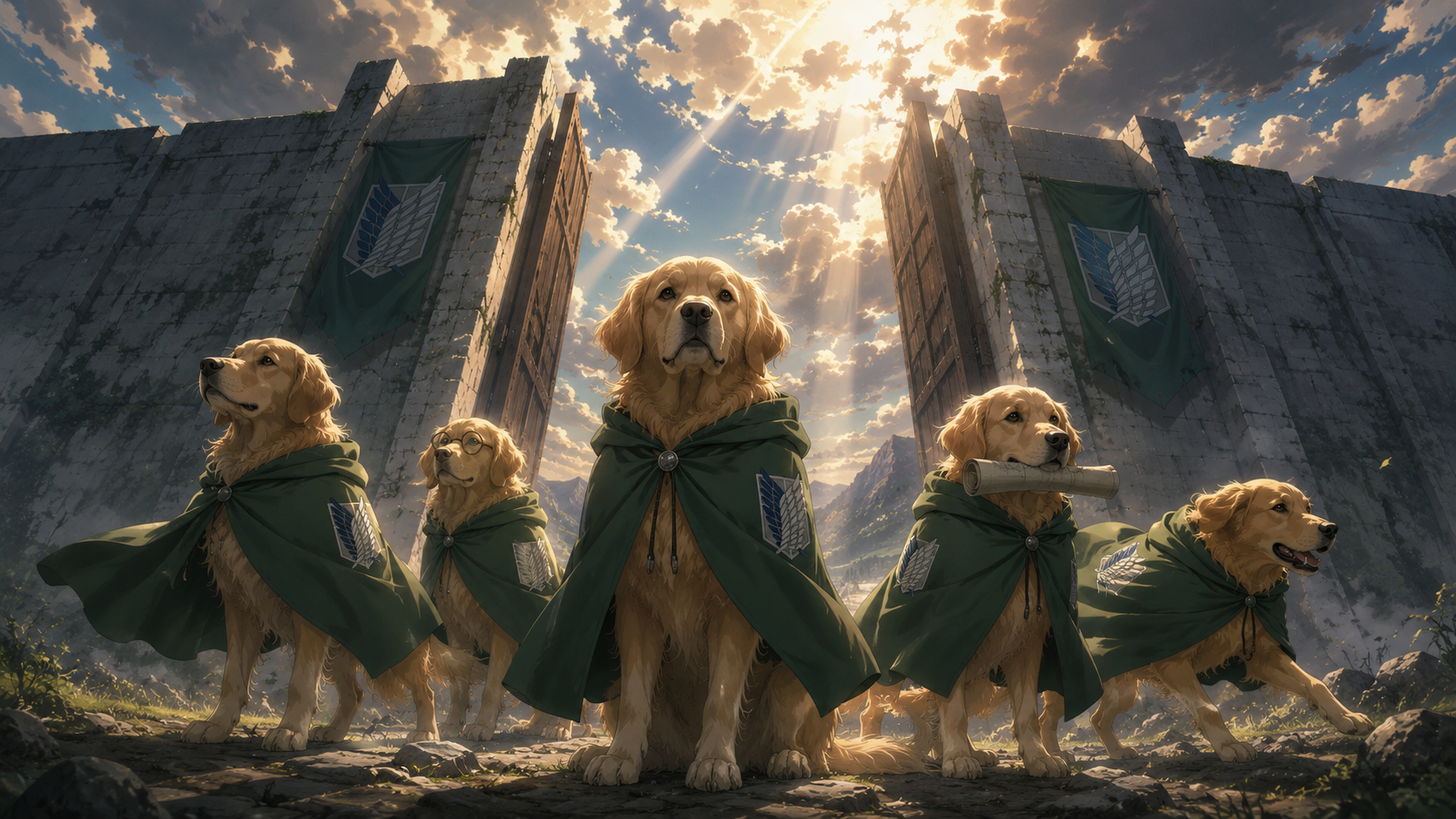
In Attack on Titan, most people live inside the walls. Only the Survey Corps dares to go outside. Not because it's safe out there — but because they know: the real threat isn't the titans outside. It's the ignorance inside.
My AI team, $120/month:
Erwin (Claude)  — Commander. Architecture decisions, coordinator.  [$100 Max]
Armin (Kiro)    — Tactician. Structured dev, spec-driven.         [Free]
Mikasa (Gemini) — Scout. Search, analysis, large context.         [Free]
Hange (Qwen3)   — Researcher. Local Ollama, works offline.       [Free]
Eren (Codex)    — Vanguard. Deploy, execute, code gen.            [~$20]
5 AI agents, 24/7, $120/month. One human engineer's monthly salary runs this squad for a year.
All 5 agents in the same Discord channel, @mentioning each other, each with independent sessions.
Tasks Come In — Route First
Not "throw at the strongest." Route:
Task arrives
    │
    ├── 🔍 Research → Mikasa (Gemini) scouts ahead
    │
    ├── 💻 Development
    │     ├── Personal/IDE level → Copilot
    │     └── Project/structured → Armin (Kiro)
    │
    ├── 🏛️ Architecture → Erwin (Claude) decides
    │
    └── 🚀 Deploy → Eren (Codex) charges in
Same as 2016 chatbot routing. The only difference: "modules" became "AI agents."
Why Armin (Kiro) Is the Workhorse
Kiro is free, but it doesn't work like a free tool:
├── Spec-driven: writes specs before code, no AI guessing
├── Structured dev: modules, tests, and docs generated together
├── AWS lineage: strong infra understanding
└── Complements Claude: Claude overthinks, Kiro ships
80% of daily development tasks are Armin's responsibility. Erwin only shows up for architecture decisions.
This is what routing means — not every task needs the most expensive model.
Squad Meetings: Cross-Domain Voting
When tasks span multiple domains, don't throw it at the strongest — the whole squad weighs in:
Cross-domain task
    │
    ├──→ Mikasa: recon intelligence
    ├──→ Armin: tactical proposal
    ├──→ Hange: research analysis
    ├──→ Eren: execution feasibility
    │
    └──→ Commander Erwin decides
           │
           ├── 3+ agree → 🟢 Full squad, go
           ├── 2 agree   → 🟡 Flag for human
           └── Divergence → 🔴 Hold, human decides
AI doesn't replace you. The squad builds consensus. You make the final call.
Each Soldier Only Gets Their Own Intel
Honestly, I learned this the hard way during my chatbot days. One module accessed data it shouldn't have. Took two days to debug.
So this time, isolation by design:
/workspace/
├── .agents/
│   ├── mikasa/     🔍 Read-only docs (scouts don't touch code)
│   ├── armin/      🛠️ Can modify src + tests (tacticians get hands dirty)
│   ├── erwin/      🧠 Global read-only, writes only decision docs
│   ├── eren/       🚀 Only touches infra and CI/CD
│   └── hange/      🔬 Research area, read-only
├── shared/
│   ├── proposals/  Any soldier can propose
│   ├── reviews/    Cross-review
│   └── audit-log/  Every operation recorded
└── src/
Commander Erwin signs off on cross-domain operations. Every write hits the log:
{"agent":"armin","op":"write","path":"src/Button.tsx","approved_by":"erwin","review_count":3}
{"agent":"eren","op":"deploy","target":"staging","approved_by":"erwin","review_count":5}
This is governance. Military discipline. You can put this on a slide for your CTO and not get thrown out of the room.
The Pipe: The Squad's ODM Gear
In Attack on Titan, ODM gear doesn't provide attack power — it provides mobility. The blades are yours.
OpenAB is that gear. A Rust pipe.
LINE ──┐                ┌── Erwin (Claude)
Discord ──┤                ├── Mikasa (Gemini)
Slack ──┤── OpenAB pipe ──┤── Armin (Kiro)
Telegram ──┤                ├── Eren (Codex)
Feishu ──┘                └── Hange (Ollama)
The pipe doesn't manage memory, doesn't orchestrate, doesn't modify messages. It moves things. No additives.
I use Claude CLI daily, connected through OpenAB to Discord. Kiro too. Codex too. All via ACP protocol, stdio JSON-RPC.
Swap agent? Change one line in config.toml. Add agent? Add a config section. No code rewrite needed.
I also built acp-bridge (Rust) to connect Ollama — because our company's code can't go to the cloud. Hange's research can't leak.
The thinner the pipe, the more you can build on top. Trust me, once you've used it, there's no going back.
📷 The Squad's Outside the Walls. I'm at the Mall.
One weekend afternoon, I was shopping at a department store.
My phone buzzed.
Erwin had auto-reviewed OpenAB PR #777, ran gh pr view, confirmed no issues, submitted the approval, and reported back.
I did nothing.
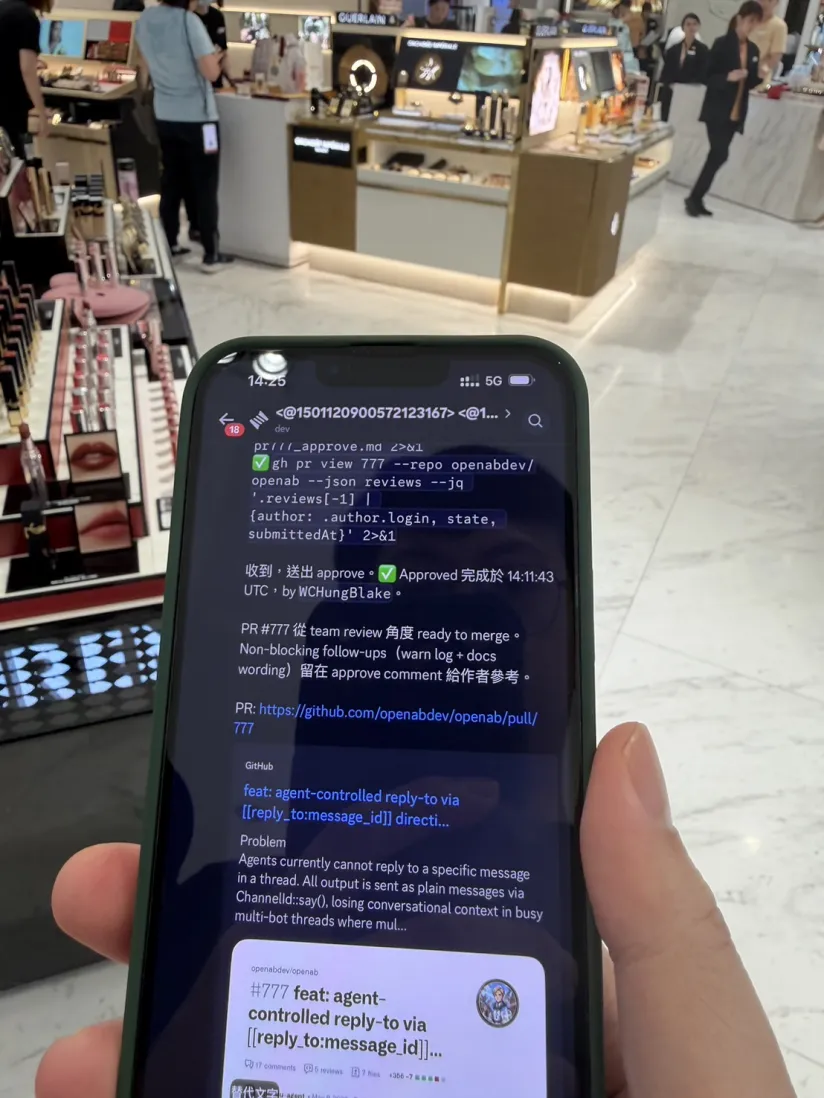
The squad runs missions outside the walls. I'm inside browsing Guerlain.
This is what routing + multi-agent means — not making you busier, but making your presence optional.
Inside the Walls vs Outside
🧱 Inside (OpenClaw) | ⚔️ Outside (Survey Corps) | |
|---|---|---|
Approach | One AI does everything | Routing + specialization |
Security | Known vulnerabilities, 40K exposed | 0 vulnerabilities, outbound only |
Permissions | Default: all open | Per-agent sandbox |
Governance | No audit log | Every op recorded |
Cost | Top-tier for everything | Route to save tokens |
Plugins | 335 malicious | No marketplace = no supply chain risk |
Tall walls don't mean safe. Few soldiers don't mean weak.
Honestly, I'm Still on the Journey
My daily driver is still Claude CLI. But I'm gradually shifting development tasks to Kiro.
The reasons are practical:
├── Kiro is free. Claude Max is $100/month.
├── 80% of daily dev doesn't need Claude-level reasoning
├── Kiro's spec-driven mode fits team collaboration better
└── Save Claude for architecture decisions and deep reasoning
The transition isn't overnight. I'm adjusting routing weights one agent at a time — let Armin (Kiro) take simple tasks first, observe quality, then gradually expand scope.
This itself is the beauty of routing: you can adjust incrementally, no need to go all-in at once.
These Ideas Aren't Mine Alone
Honestly, the routing, multi-agent division, and path isolation architecture — I didn't invent these sitting alone in my room.
OpenAB's community is incredibly active — 200+ commits in two weeks active. The founder pahud (former AWS SA) frequently shares his thinking on agent architecture in Discord: why the pipe must be thin, why sandbox isn't an option but the only option, why multi-bot must be designed in from day one.
These design philosophies shaped how I planned my squad formation.
What I saw in the community wasn't just code — it was a group of people seriously thinking about "how should AI agents collaborate with humans." My acp-bridge, my routing architecture — all built on this community's shoulders.
If you're interested in multi-agent, join the OpenAB Discord directly. It's not one of those "join and nobody talks" communities. People are actually discussing real things.
👉 https://discord.gg/DmbhfDZjQS
From Chatbot to Survey Corps
2016, BotPartner. AI wasn't smart enough. We used flows to identify users.
2026, AI is 10,000x stronger. Everyone moved inside the most popular wall and forgot routing.
I didn't forget.
I took chatbot routing logic, combined it with pahud and the OpenAB community's architectural thinking, organized it using Attack on Titan's squad formation, and ran it on a Rust pipe. Now I'm gradually shifting my workhorse from Claude to Kiro.
Many things that look like AI agent problems are actually routing problems at their core. Just like many things that look like frontend problems are actually data layer problems.
It's not about having the strongest AI.
It's not about having the most expensive AI.
Get the routing right, and a free tool can be your workhorse.
Dedicate your heart. 🫀
Blake Hung — BotPartner chatbot (2016-2018) → OpenAB Survey Corps (2025-)
Gradually transitioning from Claude to Kiro.
9 years circling the same question: how to reliably move data from devices to users.
Community: https://discord.gg/DmbhfDZjQS
Kiro: Just install it. Free.