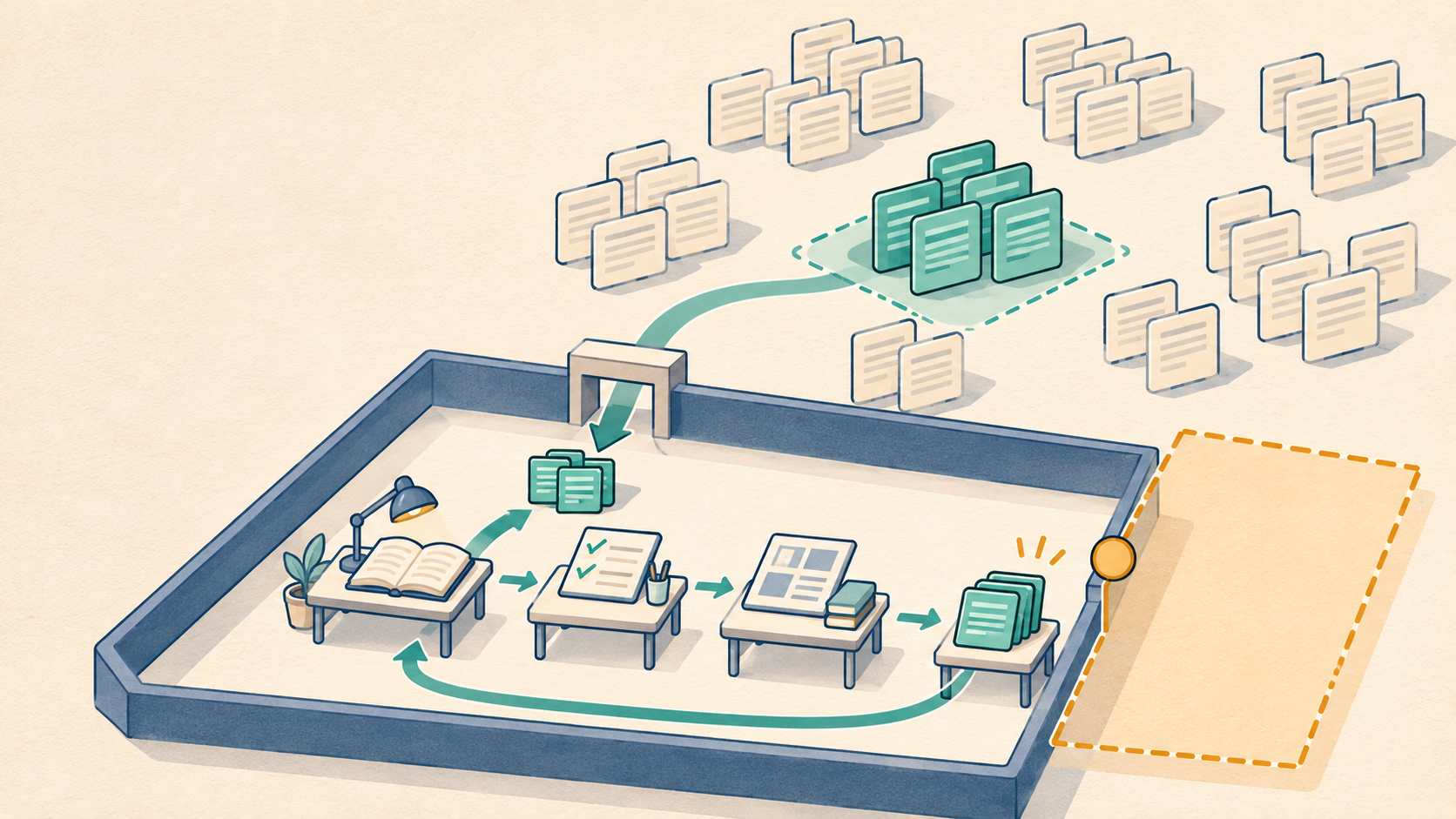
Define the information and authority available to the task before expanding its scope. The boundary is conceptual, not proof of filesystem isolation.
How I use workspaces, repeated conversation, and familiar information security principles to turn data into useful work.
Core concepts at a glance
Central claim: Useful AI work starts with a defined access boundary. Repeated conversation refines the output; additional access requires a separate scope decision.
Security concept | Meaning in this article |
|---|---|
Asset inventory and classification | Identify source data, prompts, outputs, logs, and their sensitivity |
Confidentiality, integrity, availability (CIA) | Control disclosure, verify correctness and effects, and recover useful service |
Least privilege | Limit data and capabilities to the task and required duration |
Authentication, authorization, accounting (AAA) | Establish identity, decide permissions, and record actions and outcomes |
Separation of duties and defense in depth | Assign distinct responsibilities and enforce complementary controls across layers |
Change management | Record what each scope expansion adds, who authorizes it, and when it ends |
Plan–Do–Check–Act (PDCA) | Define the boundary, work within it, verify results, and revise using evidence |
Boundary dimensions: what the agent may read, what it may do, and where it may disclose information. Permission in one dimension does not automatically grant permission in another.
Evidence distinction: linked case studies and component documentation describe published behavior. Statements about controls I would require are design requirements, not proof that those controls are deployed. A working directory is not by itself an enforced sandbox; local inference does not make every data flow local; restoring a process does not establish the outcome of an external action.
When I give work to an AI agent, I first want to understand what it can see, what it can do, and how I will check the result. Those decisions give me a basis for reviewing its work and deciding what to open next.
A workspace is where much of this starts. The documents, code, records, and previous findings I make available shape what the agent knows about my work. They also shape the quality of its answers. Too little context leaves gaps; unrelated or outdated context can send the work in the wrong direction.
My approach is to start with a relevant information set, refine the question through conversation, verify the result, and then decide whether the next round needs more access. The overall scope can grow over time, but I want each change to remain explainable.
Information security already gives us useful words for this: asset classification, least privilege, authentication and authorization, defense in depth, change management, and audit trails. This article applies that vocabulary to everyday AI work. The mapping explains my approach; it does not claim certification or verified compliance.
Start with information assets: what are we making available?
Imagine asking AI why a marketing campaign underperformed. It is tempting to give it every report, customer record, and discussion thread. Before doing that, I would identify which information actually helps answer the question.
This resembles audience segmentation. A marketing team begins with a broad population, separates it into meaningful groups, and asks increasingly specific questions. With AI, I select a relevant subset of information, inspect the initial explanation, and use the next conversation to refine it.
Here is an illustrative workflow:
Round | Information available | Intended result | Access decision |
|---|---|---|---|
1 | Public product descriptions and approved campaign copy | Candidate explanations and audience segments | Public information only |
2 | Aggregated performance for selected segments | Identify where to investigate | Add specific metrics, read-only |
3 | Approved, redacted feedback for those segments | Check explanations against customer concerns | Add selected feedback after review |
4 | Verified findings and draft messaging | Produce a proposed revision | Allow drafts in a designated folder |
5 | Reviewed proposal | Prepare for operational use | Decide separately whether to publish or contact customers |
Each round has a purpose. A useful answer might require a better question rather than another dataset. When the evidence is sufficient, I can stop expanding access.
In information security terms, this begins with an asset inventory and classification. Source files are assets, but so are prompts, outputs, conversation history, credentials, logs, and backups. Each needs an owner, an intended use, and an appropriate sensitivity level. Public, internal, confidential, and personal information should not become one undifferentiated collection simply because a model can process it.
The output needs classification too. A short summary may reveal sensitive facts from a long source document. Combining otherwise ordinary datasets may expose a relationship that none reveals alone.
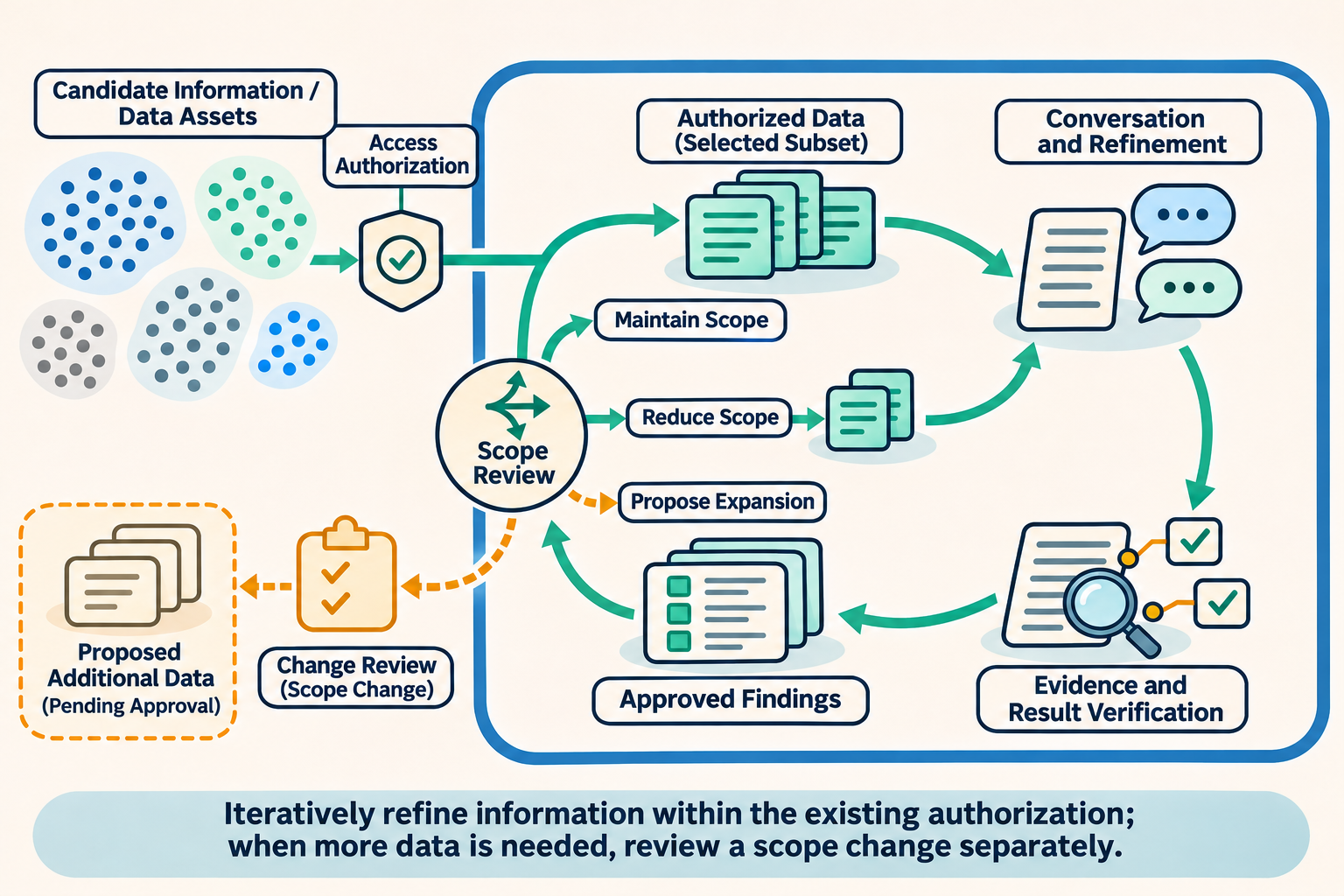
Refine information within existing authorization; review access expansion separately.
Use the CIA triad to define what “safe” means
The amount of information AI can access is an important starting point. It is only one part of the security objective.
The familiar CIA triad makes the rest explicit:
Objective | Question I ask about AI work | Example |
|---|---|---|
Confidentiality | Who or which service can receive the information? | A customer summary stays within its approved audience |
Integrity | Can I trust the source, changes, and claimed result? | A recommendation cites current records rather than an old snapshot |
Availability | Can authorized work continue or recover safely? | A failed agent can restart without repeatedly triggering the same external action |
This gives the boundary three practical dimensions: reading, acting, and disclosing. Permission to read a report does not imply permission to edit the source system. Permission to draft a message does not imply permission to send it. Permission to analyze information locally does not imply permission to upload it to another service.
That distinction matters even when the task sounds simple. “Explain these results” and “fix the campaign” can imply very different capabilities. I want the intended outcome to be clear enough that access follows the task.
Least privilege makes the workspace useful and reviewable
Least privilege means giving a task the information and capabilities it needs, for the period it needs them. For my workflow, it also encourages clearer role definitions.
In my multi-agent feature-planning case study, an architect assessed existing code and delegated scoped work with acceptance criteria. Implementation and QA roles then contributed different perspectives. That historical setup combined a cloud architect with local agents through OpenCode and Ollama. The reusable lesson is the preparation behind the exchange: define responsibilities, relevant context, and what counts as completion.
A folder is a useful way to organize that context. It is not automatically an enforced security boundary. A process's starting directory tells it where to begin; filesystem permissions, mounts, and runtime restrictions determine what else it can reach.
I separate these two questions when designing a workspace:
Is the agent being directed toward the right information?
Is access outside the permitted scope actually prevented?
A role prompt helps with the first. The second needs controls that do not depend solely on the model following instructions.
AAA: identify the request, authorize the action, retain the record
The security vocabulary of authentication, authorization, and accounting (AAA) provides a useful way to examine an agent interaction.
Authentication establishes who is making the request. Authorization determines which operation that identity may perform on a particular resource. Accounting records what was requested, decided, and done.
My trust article discusses attribution, permissions, and data sovereignty, including requester context attached to conversations. For a stronger audit trail, trusted metadata must remain distinguishable from ordinary message text. A user typing an administrator's name into a prompt must not acquire that administrator's authority.
Delegation needs the same treatment. Suppose a frontend task cannot access customer records. Asking a more privileged analyst agent to read those records and return them still crosses the original task's boundary.
The control rule I would want is:
Delegated task authority must fit within:
    the originating task's delegable scope
    intersect the receiving agent's configured permissions
    intersect what the delegated task needs
This is a design requirement, not a claim that my deployment already implements a complete capability-based delegation system. It explains why checking only the receiving agent's role is insufficient. Information returned by that agent also needs to fit the receiving task's disclosure scope.
Separation of duties adds another useful question: should the same component propose, approve, execute, and verify this action? For consequential operations, those responsibilities may need to be separated. A second agent is useful only to the extent that it has suitable authority and can examine evidence independently.
Defense in depth: where the architecture supports the boundary
These principles help explain the components I use without requiring the reader to adopt the same stack.
OpenAB provides messaging and ACP integration. Individual agent runtimes execute work. Kubernetes supplies infrastructure controls in the Pod deployment model. Local inference is an option for choosing where model requests are processed.
The logical local-model route looks like this:
Human request in Discord
    -> OpenAB: message admission, routing, session coordination
    -> agent runtime / acp-bridge
         <-> local inference service, such as Strata
         -> tools -> permitted workspace or target services
    -> result returned through OpenAB
The model proposes actions; tools run in the agent's execution environment. This diagram does not imply that the inference service is inside the same Pod.
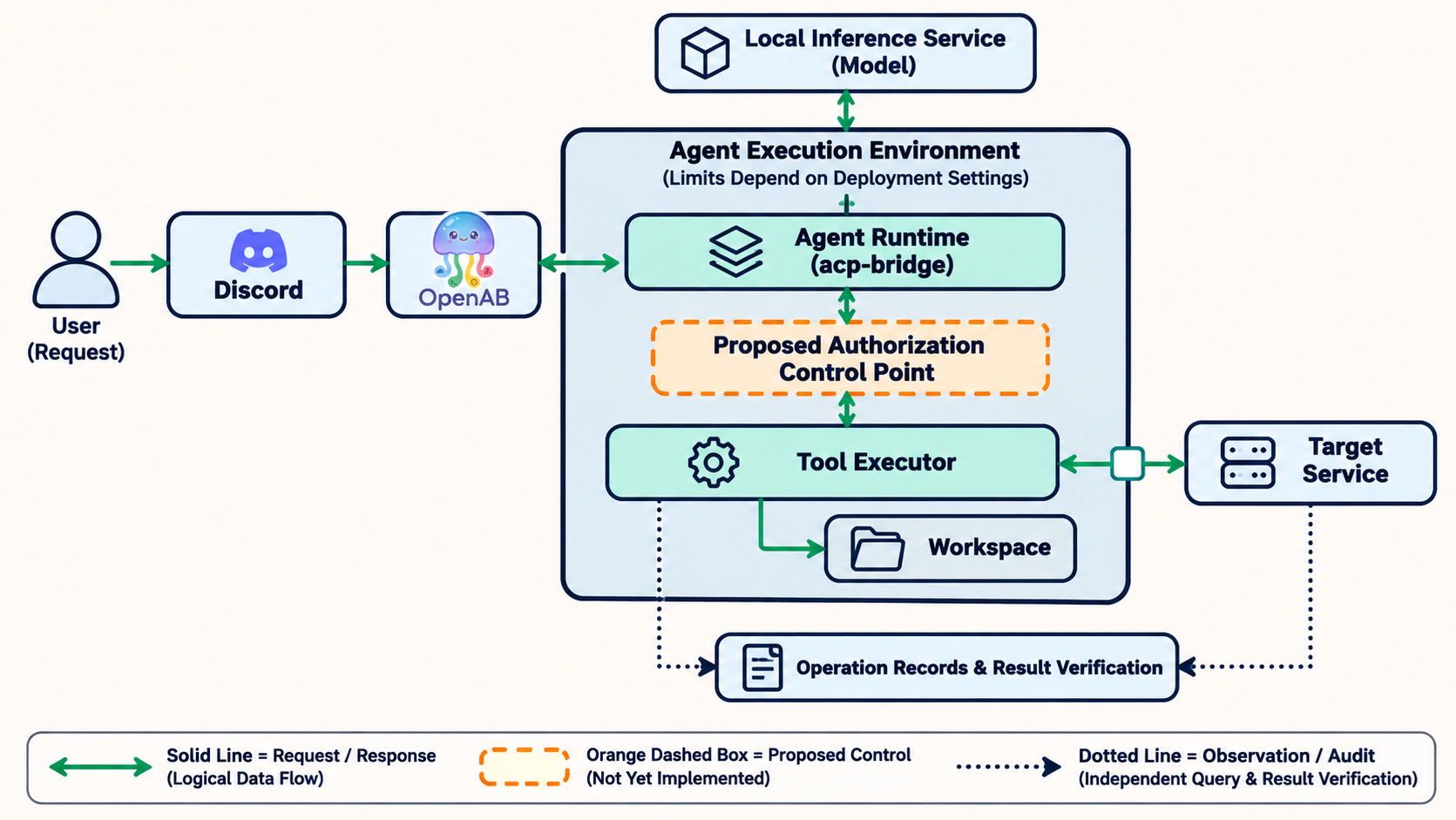
Logical architecture with a proposed authorization control point. Dotted lines represent observation and audit; independent reconciliation requires an implemented query path and cannot be established by the illustration alone.
The gateway article organizes the design around configuration, architecture, accountability, and portability. The later governance article updates the deployment direction from the earlier OpenShell descriptions to Kubernetes Pod mode. Those articles describe different stages of the design, rather than a single immutable deployment snapshot.
In security terms, defense in depth means that the layers have complementary responsibilities:
Layer | Responsibility | What I need to check |
|---|---|---|
Message admission | Decide which requests enter the workflow | Source identity and allowed channels |
Runtime and tool dispatcher | Apply execution permissions | Whether all relevant tool paths are checked |
Filesystem and process controls | Limit resources and privileges | Actual mounts, permissions, and execution identity |
Network controls | Limit destinations | Whether deployed rules are actually enforced |
Target service | Authorize the requested resource operation | Credential scope and service-side access rules |
Audit and verification | Explain the action and its effect | Durable, trustworthy evidence |
The acp-bridge project connects ACP clients to model backends and built-in tools. Its scope document draws important limits: sessions are in memory, file tools have path restrictions, and bash has no OS-level sandbox or timeout enforcement. I would therefore look to the surrounding execution environment for stronger isolation.
The Strata walkthrough demonstrates local inference and integration through acp-bridge. Choosing local inference changes the model-processing destination. It does not make a workflow using Discord, external tools, or remote logs entirely local.
There are similar limits elsewhere. A Secret injected into an agent-readable environment can be read by that agent. A stdio connection removes an inbound listener at that interface, but malicious instructions can still arrive through documents or tool results. Each control should be described in terms of the path it actually protects.
For readers exploring the components, the public repositories are OpenAB and acp-bridge. Reproducing a deployment still requires pinned versions and a sanitized configuration; project links alone do not establish its effective permissions.
Threat modeling: identify where the boundary could fail
Before choosing controls, I ask four questions: what needs protection, which inputs cannot be trusted directly, how the boundary could be crossed, and which layer prevents, detects, or helps recover from that event. This is a short threat model for the current task, not an exhaustive threat catalog.
Question | Concrete check for AI work |
|---|---|
What needs protection? | Source data, outputs, credentials, conversations, logs, backups, and sensitive relationships revealed by combining data |
Which inputs cannot be trusted directly? | Documents, web pages, tool results, other agents' messages, and pasted text; their contents cannot grant authority |
How could the boundary be crossed? | Treating instructions inside data as authorization, escalating through delegation, sending information to an unapproved destination, or repeating an action with an unknown outcome |
Which layer provides control? | Identify the runtime, filesystem, network, or target-service check and how it is verified; logs support detection, investigation, and recovery |
For example, a tool result may contain instructions to transmit information. Unverified content may also enter persistent memory and influence later tasks. I would retain such content as data requiring verification, preserve its source, and check it again before reuse, without allowing it to rewrite authorization policy. These scenarios involve indirect prompt injection and memory poisoning risks, respectively.
The function of each control matters: a prompt can guide behavior but cannot serve alone as an enforced access boundary. Audit records help detect and explain events; they do not establish that an event was prevented before execution
Integrity: verify the source and the effect
Repeated conversation can improve an answer, but agreement is not verification.
One example in the trust article involved an agent reporting a database problem from a stale local snapshot. Another queried the live database and obtained a different result. The useful lesson is to preserve the source, version, or observation time behind a claim.
I apply that distinction to actions as well. Suppose a tool creates a ticket, but its response is lost. The agent sees a timeout; the service may already contain the ticket. Retrying immediately could create a duplicate.
A recovery mechanism should be able to:
Record an operation identifier, authorization decision, target, and relevant preconditions before a consequential action.
Where the target service provides suitable idempotency guarantees, establish the key before the first attempt. Reuse that key and the same request payload for retries of the same logical operation, checking the service's scope and retention window.
Treat a lost response or timeout as an unknown outcome, not proof of non-execution.
Query the authoritative service independently for the operation identifier and resulting state. An absent record may reflect delayed visibility and does not always establish non-execution.
Do not repeat confirmed actions. Once non-execution is established, or the service's idempotency guarantees are confirmed to cover the retry safely, re-check authorization and preconditions before deciding to retry.
If safe retry cannot be established, preserve the unknown status and escalate, or use a separately authorized compensation procedure.
Renewed authorization answers whether an action is permitted now; it does not answer whether that action already happened. An operation identifier correlates records. It provides duplicate-effect protection only when the target service actually implements the corresponding idempotency mechanism.
This is a recovery contract to implement and test, not a universal feature established by the public architecture descriptions. A durable log alone does not guarantee exactly-once effects across a remote service and a crashing local process.
For shared work, I also want task ownership, source revisions, and reviewed changes to be visible. Separate worktrees can reduce edit conflicts. Operation identifiers can help investigate duplicates. A verifier needs underlying evidence rather than only the acting agent's account.
Availability: recovering an environment is only part of recovery
The governance article describes lifecycle seeding and shutdown backup. These can help rebuild an environment. They do not prove that a shutdown hook ran before a crash or establish whether an external action completed.
The recovery concepts of RTO and RPO make the requirements more concrete. RTO is the acceptable time to restore service; RPO expresses the acceptable loss of recorded state over time. Conversation history, workspace changes, and operation records can have different recovery requirements.
I would test them separately. Can the environment restart? Can the relevant records be recovered? Can an interrupted action be reconciled without an unsafe retry? The answers together describe useful recovery.
Change management: record what each expansion opens
As conversations become more useful, it is natural to ask the system to handle more. This is where change management becomes part of everyday AI use.
Before expanding scope, I want to record:
Change dimension | Example question |
|---|---|
Data | Which additional files, fields, or records become accessible? |
Actions | Does this add reading, writing, execution, or publication? |
Recipients and destinations | Can information reach another agent, model provider, service, or audience? |
Duration | When should the additional access expire? |
Authority and purpose | Who authorized it, and what task requires it? |
Verification and reversal | How will we check the change and remove access afterward? |
The decision should also account for what cannot be reversed. Removing access does not retract a document already sent elsewhere or facts retained in conversation history.
The next cycle can maintain or reduce scope as well as expand it. Success does not automatically justify more permissions.
PDCA: make the learning cycle explainable
The continuous-improvement cycle of Plan–Do–Check–Act gives the whole process a familiar structure:
Plan: define the purpose, assets, boundary, and acceptance criteria
    -> Do: work with the permitted information and capabilities
    -> Check: verify sources, outputs, actual effects, and access records
    -> Act: correct the workflow and review any proposed scope change
    -> repeat
For someone trying this approach, a practical starting point is one recurring task with a small, known dataset. Define where drafts may be written and where results may be shared. Keep track of the questions that improved the answer, the evidence used to check it, and any additional access that proved necessary.
That record makes the workflow easier to reuse and easier for another person to critique. Readers experimenting with similar systems can contribute useful evidence: a boundary that failed, an access request that was unnecessary, or a recovery test that produced a duplicate effect.
As my system grows, I want to retain the ability to explain each decision. We choose what AI can know, refine what it produces through dialogue and verification, and use evidence to decide what to open next. At every expansion, I want to identify exactly what became accessible, actionable, or shareable—and why that change was needed.
A practical AI task boundary checklist
This worksheet applies the preceding concepts to one task. Fill it in before starting, update it when scope changes, and review it at completion. Completing the worksheet does not establish that controls are implemented or verified. Mark inapplicable fields with a reason.
Task name: __________ Date: __________ Version: __________
Field | Your entry | Prompt |
|---|---|---|
Task purpose | __________ | What problem should be solved, and what are the acceptance criteria? |
Data scope (Read) | __________ | Which files, fields, or records? What source versions, observation times, and sensitivity levels? |
Permitted actions (Do) | __________ | What reading, writing locations, execution, and publication are allowed? Drafting does not automatically authorize sending. |
Recipients (Disclose) | __________ | Which people, agents, models, and services may receive source information and derived results? |
Validity period | __________ | When does access begin and end, and how does expiration or revocation work? |
Authorizer and delegation scope | __________ | Who authorizes which operations? Does delegation fit the intersection of the originating task's delegable scope, recipient permissions, and actual need? |
Verification evidence | __________ | Which sources, operation identifiers, or target states independently establish the result? |
Failure handling and revocation | __________ | How are unknown outcomes reconciled? What makes a retry safe? Who revokes access, and which disclosures cannot be undone? |
Also identify the storage locations, recipients, and retention periods for prompts, outputs, logs, memory, and backups. Set separate environment and record RTO/RPO requirements where needed.
Scope change record
Record expansion, reduction, revocation, and changes of disclosure destination. Routine actions within an existing authorization do not require a new manual approval for every step; changes beyond that scope require a decision by the appropriate authority.
Date / version | Before → after: data, actions, recipients | Task-related reason | Authorizer | Expiration | Verification and revocation |
|---|---|---|---|---|---|
__________ | __________ | __________ | __________ | __________ | __________ |
Completion review
Results have been checked against independent evidence with clear source versions or observation times.
External actions are recorded separately as completed, not executed, or unknown, with supporting evidence.
Unknown outcomes were not retried blindly; every retry has a safety basis and renewed checks of authorization and preconditions.
Temporary access has been revoked, or remaining access has a defined purpose and expiration arrangement.
External disclosures and their irreversible aspects have been recorded.
The next decision to maintain, reduce, or expand scope has been recorded with its reason.