Summary: 在 Windows 桌面應用的 Edge 端學會 Log 粒度控制和 I/O 紀律之後,到了雲端卻用
.to_dicts()把 Arrow 的 contiguous memory 炸成 770 萬個 Python 物件——Memory 膨脹 30x、GC Stop-the-World。這篇從 Webpack Hack 出發,經過 DeviceSync 在隱私權限制下的 Edge Logging 設計、Python Serialization Overhead 的底層解析、53.2x 的 Vectorization 實戰,一路走到 Apache Iceberg 的 Partition Evolution 和 Trino 的四層 Pruning。一個貫穿全程的原則:不要讓資料做不必要的旅行。Disclaimer: This is a personal learning project. All data is synthetic, generated programmatically. No real patient data is involved.
一、從 Webpack Hack 說起
在 Next.js 裡寫 Server Actions 的日子,我花了不少時間在 Webpack Hack 上。為了讓 ORM 在 server component 裡正常運作,你得在 next.config.js 裡加一堆 externals,手動把 Node.js 模組排除在 client bundle 之外。getServerSideProps 勉強能用,但你清楚這不是 "設計"——這是在框架的縫隙裡求生存。
真正讓我放棄的不是某個 bug,而是一個認知:前端框架不該負責 Data Boundary 的定義。
API 回傳的 JSON 隨著 UI 需求膨脹、欄位命名在前後端之間不一致、沒有人知道哪個欄位是 source of truth。這些問題的根因是 Data Contract 缺失。
Django REST Framework 用 Serializer 強迫你定義每個欄位的型別、驗證規則和巢狀關係。FastAPI 用 Pydantic 做同樣的事,但更快——因為 Pydantic v2 的核心是 Rust 寫的。
選擇 Python 不是因為語言本身快。而是因為 Python 生態系連接了兩個世界:一端是 Pydantic 定義的 Data Contract,另一端是 Polars、Apache Arrow 和 Apache Iceberg 構成的 Data Pipeline。這條路線在其他語言生態系中沒有對等選項。
二、DeviceSync 的教訓:當 Log 不能離開使用者的電腦
DeviceSync 是一套 Windows 桌面應用程式的 Log 系統。它面對的第一個現實不是效能——而是 隱私權。
Log 留在 Edge 端:不是選擇,是限制
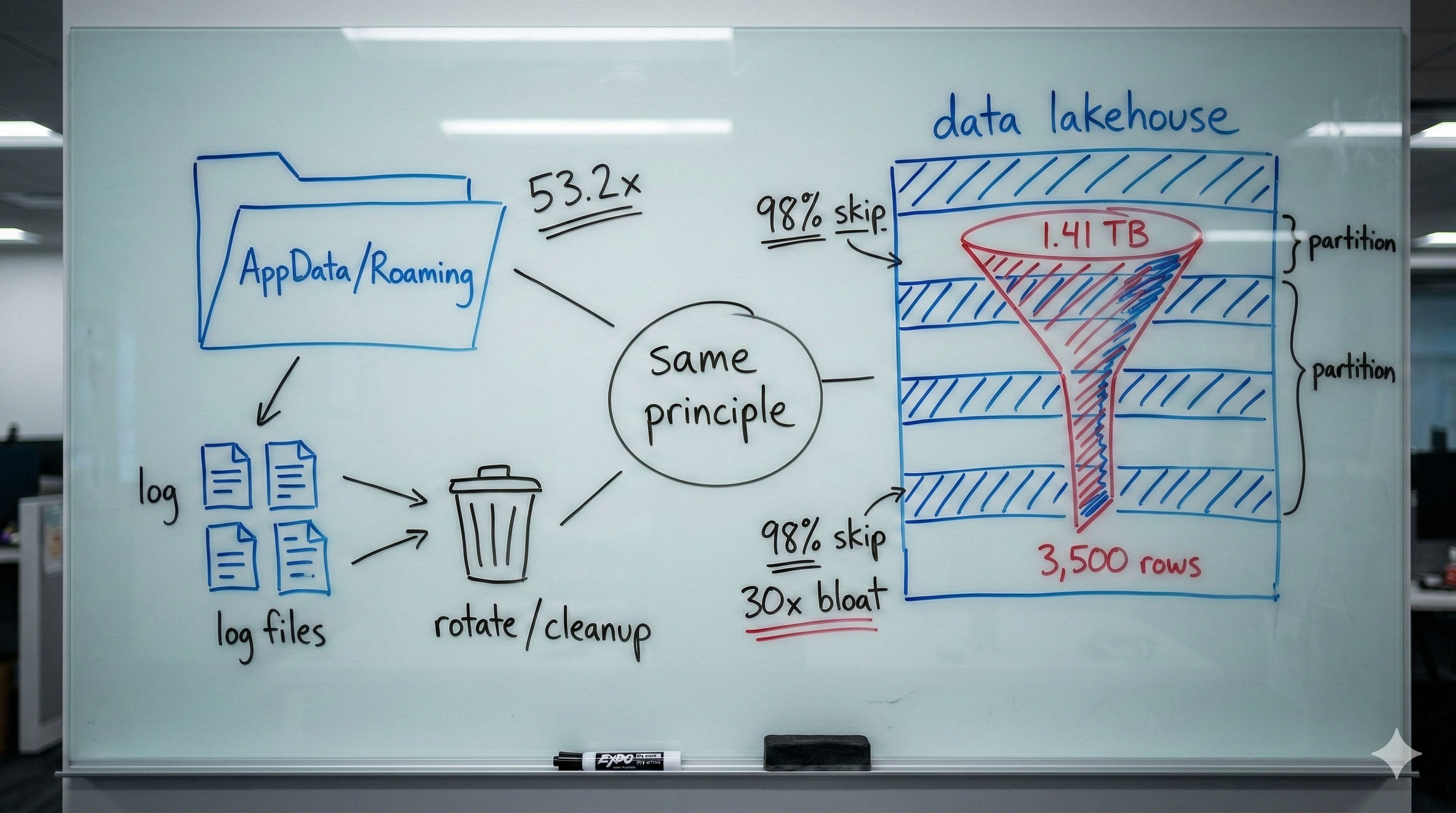
這是一個跑在使用者電腦上的 Windows 應用程式。Log 輸出在 %AppData%\Roaming 的應用程式資料夾裡——不是資料庫,不是雲端,就是本地的文字檔。
為什麼不送回伺服器?隱私權條款不允許。 使用者端的應用程式不能主動把操作記錄傳回 server。頂多能在本機建一個 SQLite,但那對客服回饋毫無幫助——客服看不到使用者電腦裡的東西。
這意味著你在設計 Log 系統時,面對的是一個根本性的矛盾:你需要足夠的 Log 來診斷問題,但你沒辦法拿到這些 Log。
三層設計:在限制中求生存
既然 Log 只能留在使用者的電腦裡,每一筆 Log 都是有成本的——它佔磁碟空間、它消耗 I/O、它可能拖慢主程式。所以設計策略不是「盡量多記」,而是「精確控制記多少」。
Registry-based Log Level Control(登錄檔控制 Log 深度):透過 Windows Registry 設定 Log 的顆粒度(Verbose / Info / Warning / Error)。這不只是技術決策——它是一個 trade-off:
顆粒度太細(Verbose):每個操作都記,Log 檔爆炸,I/O 頻繁,主程式被拖慢
顆粒度太粗(Error only):平時沒影響,但出問題時客服叫使用者寄 Log,裡面什麼都沒有
平衡點:預設 Info 等級,客服需要時透過遠端指引使用者調成 Verbose,復現問題後再調回來
Size-based Rotation(按大小壓縮刪除):Log 檔超過閾值就自動壓縮歸檔,超過保留數量就刪除最舊的。使用者的硬碟空間是別人的財產,你不能無限制佔用。
Time-based Cleanup(按時間清理):超過 N 天的 Log 自動清理。即使使用者從不打開應用程式,Log 資料夾也不會無限膨脹。
這三個設計——Log Level Control、Size Rotation、Time Cleanup——聽起來很基本。但它們背後的精神是:每一筆寫入都有成本,在資源受限的環境中,你必須精確控制 I/O 的「量」和「粒度」。
"每一筆 Log 都要問:這條記錄真的值得寫嗎?寫了之後誰能看到?" 在 Edge 端,這種潔癖是生存條件。
從 Edge 到雲端:紀律的延續與遺忘
這段經歷教會我一件事:在資源受限的環境中做工程,你會對「不必要的 I/O」極度敏感。
但奇怪的是,同一批工程師到了雲端,就忘了這個紀律。
"反正機器很多,跑慢了加 instance。" 聽起來合理,但當你的 Data Pipeline 處理百億級 CGM 血糖資料時,一個不必要的 Serialization Overhead 就能讓 Pipeline 從 52 秒膨脹到 46 分鐘。這不是加 instance 能解決的——這是架構層級的浪費。
Resource Isolation 在雲端的意思和 Edge 端一樣:控制資料的流向和粒度。 在 Edge 端,是用 Registry 控制 Log Level;在雲端,是把運算留在 Rust Engine 裡,別讓資料逃逸到 Python Heap。
底層原則從未改變:不要讓資料做不必要的旅行。
三、Python 物件化的效能陷阱
這是整篇文章最重要的段落。如果你只記一件事,記這個:不要讓資料離開 Arrow 的 Memory Format。
Arrow vs Python:Memory Layout 的戰爭
Apache Arrow 採用 Columnar Memory Format。同一欄位的所有值存放在一段 contiguous memory 中:
Arrow (glucose_mg_dl column, 966,799 rows):
┌──────────────────────────────────────────────────┐
│ 120.5 | 118.2 | 135.7 | 122.1 | ... | 119.8    │  ← contiguous 8 bytes × N
└──────────────────────────────────────────────────┘
Total: ~7.5 MB (8 bytes × 966,799)
Contiguous Memory:CPU Cache Line 一次載入 64 bytes = 8 個 float64 值
Zero-copy:Polars 和 Arrow 共享同一塊 Memory,不需要轉換
SIMD Friendly:連續排列讓 AVX2 一次處理 4 個 float64
現在看 .to_dicts() 做了什麼:
Python (after .to_dicts()):
Row 0: {"reading_id": PyUnicode(72B), "user_id": PyUnicode(64B),
        "glucose_mg_dl": PyFloat(24B), "timestamp": PyDateTime(56B), ...}
Row 1: {"reading_id": PyUnicode(72B), ...}
...
× 966,799 rows × 8 columns = 7,734,392 Python objects
每個 Python 物件的成本:
Type | Arrow Size | Python Object Size | Bloat |
|---|---|---|---|
int64 | 8 bytes | 28 bytes (PyLongObject) | 3.5x |
float64 | 8 bytes | 24 bytes (PyFloatObject) | 3x |
string | variable (dict-encoded) | 49+ bytes (PyUnicodeObject) | 5-10x |
datetime | 8 bytes | 56 bytes (PyDateTime) | 7x |
dict (per row) | N/A | 232 bytes (8-key PyDictObject) | -- |
保守估算:966,799 rows × 8 columns → 770 萬個 Python 物件 → 約 200 MB Heap。Arrow 格式下同樣的資料只有 6.5 MB。
Memory Bloat:30x。
Garbage Collection:看不見的殺手
CPython 的 Memory Management 有兩層:Reference Counting 加上 Generational GC。
770 萬個物件意味著:
770 萬次
Py_INCREF/Py_DECREF操作Gen-0 GC 的 threshold 預設是 700 個物件——你的
.to_dicts()一次製造了 700 的 11,000 倍GC 必須反覆掃描所有物件來偵測 Circular Reference
每次 GC Scan 期間,所有 Python Thread 暫停(Stop-the-World)
.to_dicts() 不只是 "比較慢"——它會把你的 Python Process 變成一台 GC Machine。
for-loop:逐 Row 的致命一擊
即使忍受了 .to_dicts() 的 Memory Bloat,接下來的 for i in range(len(rows)) 更致命:
CPython 的 Bytecode Interpreter 每個 iteration 約 100ns
96 萬次 iteration = 約 0.1 秒的純迴圈成本(什麼都不做)
每次
rows[i]["timestamp"]是一次 dict hash lookup(~50ns)每次
if gap <= 120是 Python 層級的比較(~30ns),而非 SIMD全程 GIL 鎖定,Single Thread 運行
三層浪費疊加:Serialization(Arrow → Python)+ Memory Bloat(30x)+ Interpreted Execution(no SIMD, no parallel)。
四、實戰:53.2x 的重生
在 Glucose-AI-Lakehouse-POC 專案中,有一個 CGM 血糖補值的 Pipeline。500 位使用者、966,799 筆原始讀數、需要按 FDA/ATTD 規則在 gap 處插入 imputed rows。
v1:Python for-loop(13.887s)
user_ids = df["user_id"].unique().to_list()    # 500 users
for user_id in user_ids:                       # 500× full table scan
    user_df = df.filter(pl.col("user_id") == user_id)
    rows = user_df.to_dicts()                  # Arrow → 7.7M Python objects
    for i in range(1, len(rows)):              # per-row interpreted loop
        gap = (rows[i]["timestamp"] - rows[i-1]["timestamp"])
        if gap <= 120:
            imputed_rows.append({...})         # Python dict allocation
Profiling 拆解:
Step | Time | Share |
|---|---|---|
Read Parquet | 0.038s | 0.3% |
Detect Gaps (vectorized) | 0.135s | 0.9% |
Imputation Loop | 13.887s | 95.2% |
Write Parquet | 0.293s | 2.0% |
95.2% 花在 Python 物件化 + 逐行處理。 I/O 只佔 2.3%。純粹的 CPU Bound。
v2:Polars Vectorization(0.261s)
三個 Polars Expression 取代整個 for-loop:
# 1. shift().over() — Rust Engine 內取前一筆,Zero Serialization
df = df.with_columns([
    pl.col("timestamp").shift(1).over("user_id").alias("_prev_ts"),
    pl.col("glucose_mg_dl").shift(1).over("user_id").alias("_prev_glucose"),
])

# 2. int_ranges().explode() — Gap fan-out in Rust,Zero Python Object
imputed = gaps.with_columns(
    pl.int_ranges(1, pl.col("_num_missing") + 1).alias("_offset")
).explode("_offset")

# 3. when().then().otherwise() — Vectorized Conditional,SIMD Friendly
imputed = imputed.with_columns(
    pl.when(pl.col("gap_duration_minutes") <= 30)
      .then(linear_interpolation_expr)
    .when(pl.col("gap_duration_minutes") <= 120)
      .then(pl.col("_prev_glucose"))      # LOCF
    .otherwise(pl.lit(None))               # NULL for >2hr gaps
    .alias("glucose_mg_dl")
)
結果
Metric | v1 (for-loop) | v2 (Vectorized) | Improvement |
|---|---|---|---|
Imputation Core | 13.887s | 0.261s | 53.2x |
Quality Layer | 14.585s | 0.694s | 21.0x |
Full Pipeline | 14.943s | ~1.285s | 11.6x |
Total Rows | 1,079,888 | 1,079,888 | Exact Match |
LOCF Count | 85,889 | 85,889 | Exact Match |
NULL Count | 27,200 | 27,200 | Exact Match |
6 項 Validation Metrics 完全一致。不是近似,是 Exact Match。
53.2x 不只是 "少了 Serialization"。shift().over() 底層是 Rust 的 Parallel Iterator,自動利用多核心。Python for-loop 是 Single-threaded + GIL。提升來自三層紅利疊加:Zero Serialization + Rust Parallelism + SIMD Vectorization。
Production 100K users 推算:v1 需要 46 分鐘,v2 只需要 52 秒。
五、Iceberg:從 Edge I/O 到 Lakehouse Governance
把 Resource Isolation 的精神從 DeviceSync 帶到 Lakehouse:不要讀不需要的資料。
Apache Iceberg 解決的問題,和我們在 Edge 端面對的問題驚人地相似。在 DeviceSync 我們學會 "不必要的東西不要寫,寫了的東西要控制粒度和生命週期"。在 Iceberg,這個概念變成了 Hidden Partitioning。
Partition Pruning:I/O Optimization 的延續
315 億筆 CGM 資料,分佈在 4 個國家、36 個月。不分區 → 每次查詢掃描全部 1.41 TB。用 country + month(timestamp) 分區後:
總分區數:144 個(4 x 36)——100-1,000 Sweet Spot 內
查詢 "TW + January" 只讀 1/144——Skip 99.3%
單一分區最大 327M rows,在 Trino 建議的 100M-500M 範圍內
Schema & Partition Evolution
還記得 DRF Serializer 嗎?API Contract 變更時需要 versioning 和 backward compatibility。
Iceberg 的 Schema Evolution 做同一件事:加欄位、改型別、重新命名——不需要 rewrite data。
更強的是 Partition Evolution:傳統 Hive 改 Partition Strategy = rewrite 315 億筆(預估 2-4 小時 downtime)。Iceberg 只需要一行 DDL:
ALTER TABLE cgm_readings SET PARTITION SPEC (
    identity(country),
    day(timestamp)  -- changed from month to day
)
舊資料不動,新資料自動用新 Partition。Zero downtime, zero rewrite。
這不只是 feature——這是 Governance Philosophy:系統應該能在不中斷服務的情況下演進。
六、Trino:不移動資料的 Distributed Computation
Trino 解決另一個問題:Compute-Storage Separation。
PostgreSQL 把資料和運算綁在同一台機器上。想更快?加 CPU、加 Memory、加 replica。Vertical Scaling 有天花板,Horizontal Scaling 有 consistency 問題。
Trino 的做法:資料留在 S3,Compute 用完即釋放。
為什麼 315 億筆能 Sub-second 回傳?
答案不是 "Trino 很快"——這太籠統。具體的加速來自四層 Pruning:
Layer | Mechanism | Effect |
|---|---|---|
Partition Pruning | 只讀 | Skip 99.3% |
File-level Min/Max | Parquet Footer Statistics | Skip ~80% |
Row Group Pruning | Row Group 內的 min/max | Skip ~50% |
Column Projection | 只讀需要的 2/8 columns | Save 75% I/O |
四層疊加後,315 億筆的查詢實際只掃描約 3,500 筆。這不是魔法,是 Structured Laziness——能不讀的,絕對不讀。
從 Edge 到 Lakehouse 的一致性
DeviceSync (Edge) | Iceberg + Trino (Lakehouse) | 共同原則 |
|---|---|---|
Registry Log Level Control | Column Projection(只讀需要的欄位) | 控制粒度:不需要的資訊不要產生 |
Size-based Rotation | Partition Pruning(只讀需要的分區) | 控制 I/O:不需要的資料不要讀 |
Time-based Cleanup | Iceberg Snapshot Expiry | 控制生命週期:過期的資料不要留 |
底層邏輯從未改變。改變的是規模:從單機 AppData\Roaming 裡的 MB 級 Log,到分散式的 TB 級 Lakehouse。
七、Data Contract:FastAPI + Pydantic
問題不是 Python 不行。問題是你讓 Python 做了它不該做的事。
正確的設計哲學是:Python 是 Orchestrator,Rust 是 Executor。
Boundary:Pydantic Validation
在資料 Ingestion 和 API 輸出端,用 FastAPI + Pydantic 定義 Data Contract:
class CGMReading(BaseModel):
    user_id: str
    timestamp: datetime
    glucose_mg_dl: float = Field(ge=20, le=600)
    country: Literal["TW", "JP", "KR", "SG"]

    model_config = ConfigDict(strict=True)
Pydantic v2 的 Validation Core 是 Rust 寫的(pydantic-core),比 v1 快 5-50x。它只在 Boundary 做一次 Validation,之後資料進入 Arrow Format 就不再需要 Python 物件化。
Pipeline 內:全程 Arrow
Layer | Tool | Runtime | Data Format |
|---|---|---|---|
API Boundary | FastAPI + Pydantic | Rust (core) | Python Object(僅一次) |
Read/Write | Polars read/write_parquet | Rust | Arrow IPC |
Computation | Polars Expressions | Rust | Arrow Columnar |
Storage | Parquet on S3 | C++ (Arrow) | Columnar + Compressed |
Python 在這條鏈路上的角色:定義 DAG、呼叫 API、處理錯誤。所有碰觸資料的運算,都在 Rust 裡完成。
一條禁令
如果你在 Data Pipeline 中看到以下任何一行,請立即重構:
# 以下每一行都是效能殺手
df.to_dicts()           # Arrow → Python dict list (30x Memory Bloat)
df.to_pandas()          # Arrow → NumPy (copy) → Pandas
df.iter_rows()          # Per-row Iteration = 放棄 Vectorization
for row in df.rows():   # 同上
[row for row in df]     # 同上的語法糖
替代方案永遠是:用 Polars Expression 表達邏輯,讓 Rust 去跑。
八、結語
從 Next.js 的 Webpack Hack 到 Polars 的 shift().over(),技術棧變了,但底層原則沒變:
"資料流過 Boundary 時,要有明確的 Contract。資料在 Boundary 內時,不要讓它離開原生 Format。"
Pydantic 守住 Boundary 的 Contract
Polars 守住 Boundary 內的 Memory Format
Iceberg 守住 Storage Layer 的 Governance
Trino 守住 Compute Layer 的 Resource Isolation
一個 Senior Data Engineer 的價值不是知道 .to_dicts() 很慢——任何人跑一次 benchmark 都看得出來。價值在於能解釋 為什麼 慢(Serialization + Memory Bloat + GC + GIL),能預測 影響多大(100K users 從 52 秒變 46 分鐘),能給出 決策建議(三個 Polars Expression 取代整個 for-loop,53.2x 提升,6 項 Metrics Exact Match)。
"不能只跑數字,要能解釋數字。" 這是從 Edge Device 到 Data Lakehouse,一路學到的最重要的事。
所有數據來自個人學習專案 Glucose-AI-Lakehouse-POC,使用程式化生成的合成資料。